First motorhome trip – everything you need to know before you go
First time in a motorhome? This complete guide covers your driving licence, vehicle handover, onboard systems, packing, parking and the most common beginner mistakes.
Your first motorhome trip – a complete beginner's guide
A motorhome looks complicated at first glance. Large vehicle, water tanks, gas, chemical toilet, electrics... where do you start? Relax. By the end of this article you'll know exactly what to expect – from your driving licence to your first night at a campsite.
---
Do I need a special driving licence?
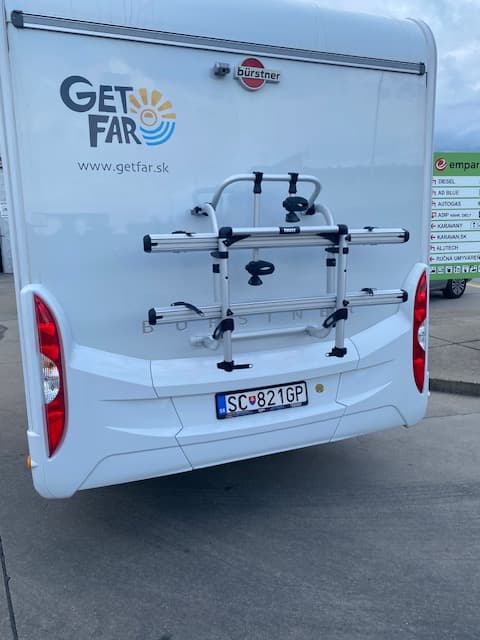
This is the most common beginner question. The answer is simple: **no**. Our Bürstner T 726 G motorhomes only require a standard **category B** driving licence.
Our vehicles weigh up to 3,500 kg – exactly at the limit of category B. You don't need category C, a B96 extension or any additional tests. The only requirements are:
If you meet these conditions, you're ready to go.
---
Vehicle handover – what to expect
When you collect the motorhome from GetFar in Nová Dedinka, you won't just leave with the keys. We spend **1 to 1.5 hours on a thorough walkthrough**, covering every system in the vehicle.
What we'll show you:
Don't be afraid to ask questions. We're here for you and happy to answer everything – no matter how basic it seems.
---
Onboard systems – how it all works
Water
Our vehicle has a **125-litre fresh water tank** and a 90-litre waste tank. You fill the tank at the campsite using the hose (virtually every campsite has a water point), or we can pre-fill it for you.
With normal use (shower, washbasin, cooking), 125 litres will last a family of 4 **2–3 days**. Manage it sensibly – short showers, turn off the tap while soaping up.
Electricity
The motorhome has two electrical systems:
Always plug in at the campsite – it extends battery life and lets you comfortably charge phones, tablets and laptops.
Gas
An 11kg propane bottle is included in the rental price. It powers the 3-burner gas stove and hot water for the shower. A bottle typically lasts an **entire two-week holiday** with normal use.
Heating
The Truma Combi 6 is a reliable system that heats both air and water. It runs on gas. At night, set a low temperature (around 17–18°C) – you'll save gas and sleep better.
Chemical toilet
The chemical toilet is a closed system with a waste cassette. The cassette is emptied at dedicated dump stations, which every decent campsite has. We'll walk you through the process in detail at handover.
---
What to pack – complete checklist
Clothing
Food and kitchen
Documents
Practical extras
For children
---
Your first day at the wheel – what to watch out for
Driving a motorhome isn't difficult – just different. A few things to keep in mind:
**Vehicle height:** 3.5m. Watch clearances in tunnels and car parks. Most restaurant car parks are fine; watch out for low trees or covered garages.
**Vehicle length:** 7.38m. Allow more space when turning. The rear swings differently to what you're used to.
**Width:** 2.32m excluding mirrors. Take care on narrow campsite lanes.
**Rear visibility:** You only have mirrors, no rear window. Reverse slowly and rely on them. Use your sat-nav.
**Practical tip:** Before your first long drive, spend 15 minutes in a quiet area or car park to get a feel for the vehicle. After half an hour you'll feel like a seasoned driver.
---
Where to park and camp
Traditional campsites
The most comfortable option with electrical and water hookups, bathroom facilities and usually a shop. In season (July–August), book **at least 2 weeks in advance**.
Recommended apps:
Stellplatz / Aire
Paid motorhome parking areas without full campsite facilities. Cheaper, quieter, less campsite noise. Popular for slow travel.
Wildcamping in Slovakia
Short-term stopping (without overnight stays) is generally tolerated in most public areas in Slovakia. Longer stays in nature depend on the specific location and local regulations. Overnight stays outside designated areas in national parks are prohibited.
---
Most common beginner mistakes (and how to avoid them)
---
Final thoughts
Your first motorhome trip is the kind of experience that makes most people say: *"Why didn't we try this sooner?"* It's a little different from a regular holiday, but the freedom and comfort are worth it.
Still have questions? Check our [FAQ page](/en/faq) or [contact us](/en/kontakt) directly. And when you're ready – [book your motorhome](/en/rezervacia) and experience it for yourself.